Introduction
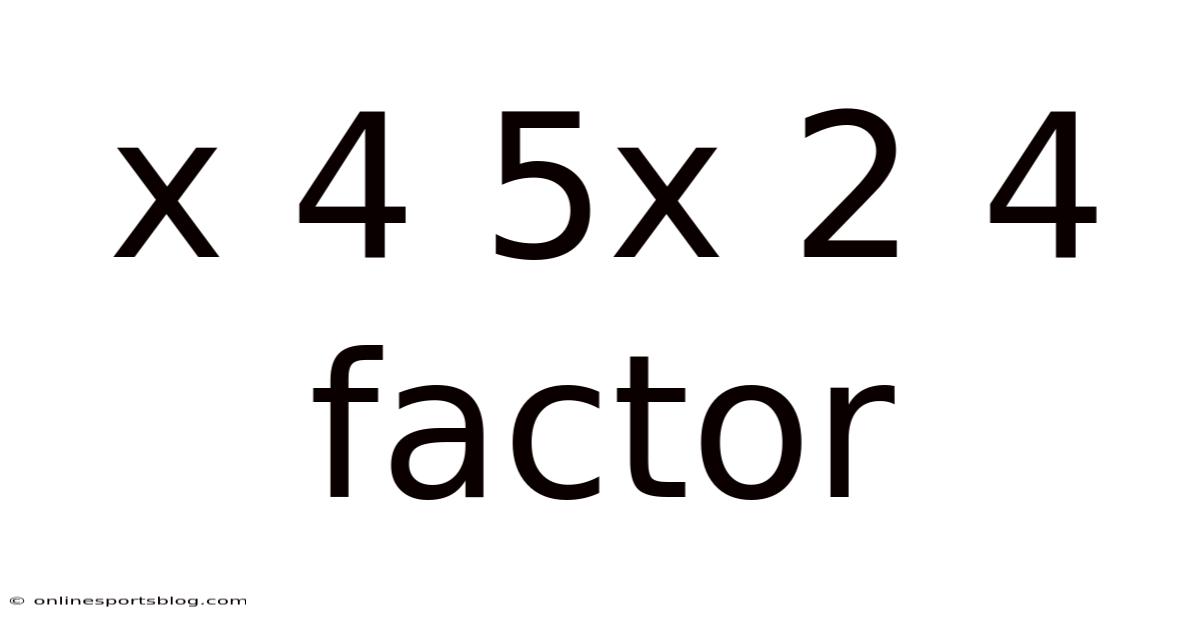
Factoring polynomial expressions is a fundamental skill in algebra that transforms a seemingly complex equation into a product of simpler factors. One common exercise that appears in high‑school curricula is the factorisation of the quartic polynomial
[ x^{4}+5x^{2}+4 . ]
At first glance this expression may look intimidating because of the fourth‑degree term, but by recognising patterns and applying systematic techniques it can be broken down into a product of quadratic or linear factors. This article walks you through every step of the process, explains the underlying mathematical ideas, and provides several variations and practice problems so you can master the technique and apply it confidently in exams, homework, or real‑world problem solving.
1. Understanding the Structure of the Polynomial
1.1 Recognising a “quadratic in disguise”
The polynomial (x^{4}+5x^{2}+4) contains only even powers of (x): (x^{4}) (which is ((x^{2})^{2})), (x^{2}), and the constant term (4). By substituting
[ y = x^{2}, ]
the expression becomes
[ y^{2}+5y+4. ]
Now the problem is reduced to factoring a quadratic in the variable (y). This substitution is the cornerstone of many factorisation problems involving even powers.
1.2 Standard quadratic factoring
A quadratic (y^{2}+by+c) can be factored when two numbers (p) and (q) satisfy
[ p+q = b \quad\text{and}\quad pq = c . ]
For our case (b=5) and (c=4). The pair ((p,q) = (1,4)) meets both conditions because
[ 1+4 = 5,\qquad 1\cdot4 = 4 . ]
Therefore
[ y^{2}+5y+4 = (y+1)(y+4). ]
2. Re‑substituting the Original Variable
Having factored the quadratic in terms of (y), we now replace (y) with (x^{2}):
[ (y+1)(y+4) ; \longrightarrow ; (x^{2}+1)(x^{2}+4). ]
Thus the original quartic polynomial factors as
[ \boxed{x^{4}+5x^{2}+4 = (x^{2}+1)(x^{2}+4)}. ]
Both factors are irreducible over the set of real numbers because they contain no real roots (their discriminants are negative). If the context requires factoring over the complex numbers, each quadratic can be split further:
[ \begin{aligned} x^{2}+1 &= (x+i)(x-i),\ x^{2}+4 &= (x+2i)(x-2i), \end{aligned} ]
where (i = \sqrt{-1}). Over the integers, the factorisation stops at ((x^{2}+1)(x^{2}+4)).
3. Alternative Factoring Techniques
While the substitution method is the most straightforward for this particular polynomial, it is useful to be familiar with other strategies that may be required in different contexts.
3.1 Grouping
If the polynomial had more terms, you could try to group them into pairs that share a common factor. Here's one way to look at it: consider
[ x^{4}+5x^{2}+4 = (x^{4}+4x^{2}) + (x^{2}+4). ]
Factoring (x^{2}) from the first group and (1) from the second gives
[ x^{2}(x^{2}+4) + 1(x^{2}+4) = (x^{2}+1)(x^{2}+4), ]
which arrives at the same result without an explicit substitution.
3.2 Using the “sum of squares” pattern
The expression can also be seen as a sum of two squares with a middle term:
[ x^{4}+5x^{2}+4 = (x^{2})^{2}+2\cdot\frac{5}{2}x^{2}+4. ]
If you recognise the pattern ((a+b)^{2}=a^{2}+2ab+b^{2}), you might attempt to write the polynomial as a perfect square plus a remainder, then adjust. Even so, this route is more cumbersome for the given coefficients and is generally less efficient than the substitution method Small thing, real impact..
3.3 Factoring by inspection
For seasoned algebraists, spotting the factor pair ((x^{2}+1)(x^{2}+4)) can be immediate. In practice, the reason is that the constant term (4) suggests possible constant factors (1) and (4) (or (-1) and (-4) if the sign were negative). Since the middle term is positive, both constants must be positive, leading directly to the factorisation The details matter here..
4. Why This Factorisation Matters
4.1 Solving equations
If you need to solve (x^{4}+5x^{2}+4=0), the factorisation instantly yields
[ (x^{2}+1)(x^{2}+4)=0 ;\Longrightarrow; x^{2}=-1 ;\text{or}; x^{2}=-4. ]
Hence the solutions are
[ x = \pm i,\qquad x = \pm 2i, ]
which are all complex numbers. Knowing the factorisation saves you from applying the quartic formula—a far more complicated and error‑prone method Nothing fancy..
4.2 Integration and calculus
When integrating rational functions that involve the denominator (x^{4}+5x^{2}+4), partial fraction decomposition requires the polynomial to be expressed as a product of irreducible quadratics. The factorisation we derived provides exactly that, enabling a clean decomposition:
[ \frac{1}{x^{4}+5x^{2}+4}= \frac{A x + B}{x^{2}+1} + \frac{C x + D}{x^{2}+4}, ]
where (A,B,C,D) are constants determined by the usual method. This step is essential in many calculus problems Which is the point..
4.3 Geometry and physics
Polynomials of the form (x^{4}+ax^{2}+b) appear in the analysis of pendulum motion, optical systems, and signal processing where the characteristic equation of a system yields a quartic with only even powers. Factoring them quickly reveals natural frequencies or resonance conditions.
5. Frequently Asked Questions
Q1. Can the polynomial be factored over the integers in any other way?
No. The only integer factorisation is ((x^{2}+1)(x^{2}+4)). Any attempt to produce linear integer factors would require a real root, but the polynomial has none because its discriminant (when treated as a quadratic in (x^{2})) is positive, yet the roots of (x^{2}) are negative, leading to imaginary (x) It's one of those things that adds up..
Q2. What if the middle coefficient were negative, e.g., (x^{4}-5x^{2}+4)?
You would look for two numbers whose product is (4) and whose sum is (-5). The pair ((-1,-4)) works, giving
[ x^{4}-5x^{2}+4 = (x^{2}-1)(x^{2}-4) = (x-1)(x+1)(x-2)(x+2). ]
Thus the sign of the middle term determines whether the quadratic factors contain plus or minus signs.
Q3. Is completing the square useful for quartic polynomials?
Completing the square is primarily a technique for quadratics. For quartics that are “bi‑quadratic” (only even powers), the substitution method is essentially the same idea: treat (x^{2}) as a new variable and complete the square in that variable if needed. Directly completing the square on the original quartic is rarely efficient.
Counterintuitive, but true.
Q4. How does the factorisation change if we work modulo a prime, say modulo 5?
Working modulo 5, the polynomial becomes
[ x^{4}+5x^{2}+4 \equiv x^{4}+0\cdot x^{2}+4 \equiv x^{4}+4 \pmod{5}. ]
Now we need to find factors in (\mathbb{F}{5}[x]). Still, it can factor as a product of two quadratics, e.Testing values (x=0,1,2,3,4) shows that none give zero, so the polynomial has no linear factor over (\mathbb{F}{5}). g.
[ x^{4}+4 = (x^{2}+2x+2)(x^{2}+3x+2) \pmod{5}, ]
which can be verified by expansion. This illustrates that factorisation is field‑dependent.
Q5. Can I use a graphing calculator to confirm the factorisation?
Yes. Plotting (y = x^{4}+5x^{2}+4) will show that the curve never crosses the x‑axis (no real roots). If you plot the two quadratics (y = x^{2}+1) and (y = x^{2}+4) separately, you’ll see that their product reproduces the original curve, confirming the factorisation visually That alone is useful..
6. Step‑by‑Step Summary
- Identify the pattern – only even powers → substitute (y = x^{2}).
- Rewrite – obtain a quadratic (y^{2}+5y+4).
- Find two numbers whose sum is 5 and product is 4 → 1 and 4.
- Factor the quadratic → ((y+1)(y+4)).
- Back‑substitute – replace (y) with (x^{2}) → ((x^{2}+1)(x^{2}+4)).
- Optional complex factorisation – further split each quadratic if required.
7. Practice Problems
- Factor (x^{4}+7x^{2}+10).
- Factor (x^{4}-3x^{2}+2) over the real numbers.
- Factor (x^{4}+6x^{2}+9) and express the result as a perfect square if possible.
- Over the field (\mathbb{F}_{7}), factor (x^{4}+2x^{2}+1).
Solutions
- Substitute (y=x^{2}): (y^{2}+7y+10 = (y+5)(y+2) \Rightarrow (x^{2}+5)(x^{2}+2)).
- (y^{2}-3y+2 = (y-1)(y-2) \Rightarrow (x^{2}-1)(x^{2}-2) = (x-1)(x+1)(x^{2}-2)).
- (y^{2}+6y+9 = (y+3)^{2} \Rightarrow (x^{2}+3)^{2}).
- In (\mathbb{F}_{7}), (x^{4}+2x^{2}+1 = (x^{2}+1)^{2}) because (2 \equiv 2) and (1^{2}=1).
8. Conclusion
Factoring the quartic polynomial (x^{4}+5x^{2}+4) showcases a classic algebraic technique: recognising a quadratic hidden inside a higher‑degree expression. By substituting (y = x^{2}), the problem collapses to a simple quadratic that can be factored by inspection or the standard “product‑sum” method. Re‑substituting the original variable yields the clean factorisation ((x^{2}+1)(x^{2}+4)), which is irreducible over the reals but can be further split over the complex numbers Small thing, real impact..
This changes depending on context. Keep that in mind.
Mastering this approach equips you to tackle a wide range of bi‑quadratic polynomials, simplifies solving equations, aids in calculus operations such as partial fractions, and even supports applications in physics and engineering. Practice with the provided problems, experiment with alternative methods like grouping, and explore factorisation in different number systems to deepen your understanding. With these tools, you’ll turn any “x⁴ + …” expression from a stumbling block into a straightforward, solvable puzzle.
