Introduction
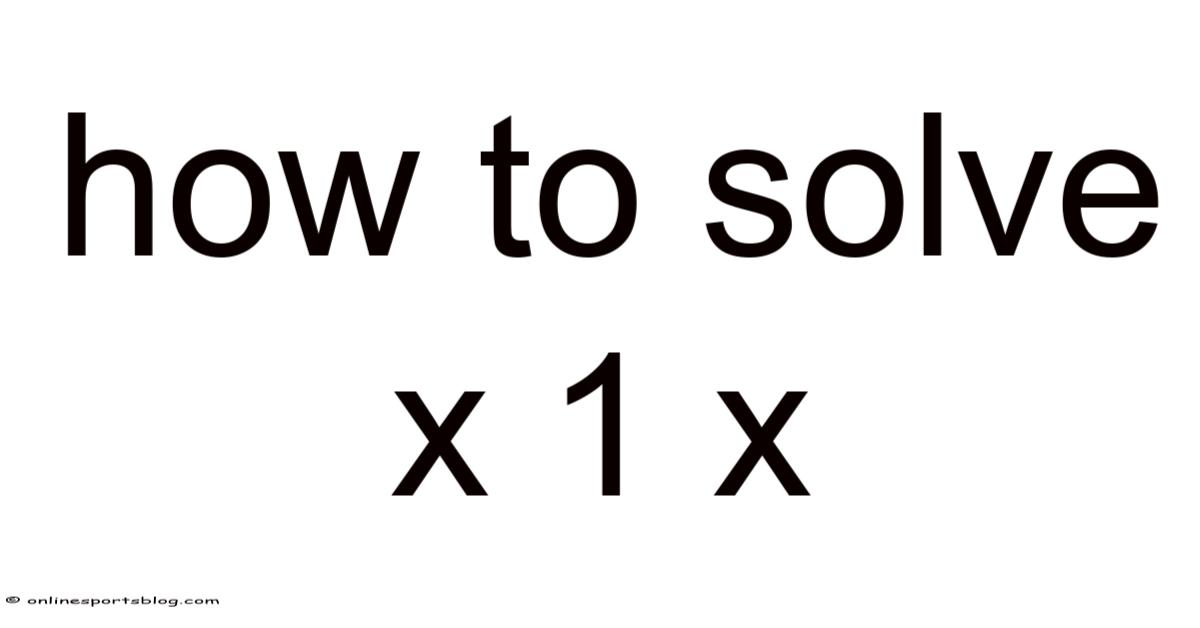
Solving the equation x = 1⁄x is a classic problem that appears in middle‑school algebra, high‑school mathematics competitions, and even in introductory calculus courses. Despite its simple appearance, the equation hides several important concepts: the idea of reciprocal numbers, the handling of extraneous solutions, and the use of algebraic manipulation to isolate the variable. Think about it: this article walks you through every step needed to solve x = 1⁄x, explains the underlying mathematics, and answers common questions that students often ask. By the end, you will not only know the solution(s) but also understand why those solutions are the only ones that satisfy the original equation.
1. Understanding the Equation
The statement x = 1⁄x tells us that a number is equal to its own reciprocal. In plain terms, multiplying the number by itself must give 1:
[ x \times x = 1 ]
This observation is the key to solving the problem. Before we start manipulating symbols, let’s recall two essential rules:
- Reciprocal definition – For any non‑zero number a, the reciprocal is (1/a). The number 0 has no reciprocal because division by zero is undefined.
- Multiplication property of equality – If two expressions are equal, you may multiply both sides by the same non‑zero quantity without changing the truth of the statement.
Keeping these rules in mind prevents us from accidentally introducing illegal operations, such as multiplying by zero Simple as that..
2. Step‑by‑Step Solution
Step 1: Eliminate the fraction
Multiply both sides of the equation by x (remember, we must assume x ≠ 0 because the original equation contains the term (1/x)):
[ x \cdot x = \frac{1}{x} \cdot x ]
Simplifying gives:
[ x^{2} = 1 ]
Step 2: Solve the quadratic
The equation (x^{2}=1) is a simple quadratic. Bring all terms to one side to see the standard form:
[ x^{2} - 1 = 0 ]
Factor using the difference‑of‑squares identity:
[ (x - 1)(x + 1) = 0 ]
A product equals zero only when at least one factor is zero, so we set each factor to zero:
[ \begin{cases} x - 1 = 0 \quad \Rightarrow \quad x = 1 \ x + 1 = 0 \quad \Rightarrow \quad x = -1 \end{cases} ]
Step 3: Verify the solutions
Because we multiplied the original equation by x, we must check that each candidate satisfies the original statement x = 1/x Worth keeping that in mind..
-
For x = 1:
[ 1 = \frac{1}{1} \quad \text{(true)} ] -
For x = –1:
[ -1 = \frac{1}{-1} = -1 \quad \text{(true)} ]
Both values pass the verification, and neither violates the condition x ≠ 0. So, the complete solution set is:
[ \boxed{{, -1,; 1 ,}} ]
3. Why Zero Is Not a Solution
A common mistake is to plug x = 0 into the original equation and claim it works because (0 = 1/0) seems “undefined = undefined.” In mathematics, an expression that is undefined cannot be equated to anything else; it simply does not belong to the set of real numbers. Since the reciprocal (1/x) is undefined at x = 0, the original equation is not defined for that value, and therefore 0 cannot be a solution Surprisingly effective..
4. Extending the Idea: Solving (x = \frac{k}{x})
The same technique works for a more general form:
[ x = \frac{k}{x} ]
where k is a non‑zero constant. Multiplying both sides by x yields (x^{2}=k). Solving for x gives:
[ x = \pm\sqrt{k} ]
Again, we must verify that k is non‑negative when we restrict ourselves to real numbers; otherwise, the solutions are complex. This generalization shows how the simple problem x = 1/x is a special case with k = 1.
5. Graphical Interpretation
Plotting the functions (y = x) and (y = 1/x) on the same coordinate plane provides an intuitive visual proof. Their intersection points are precisely the solutions we derived algebraically: ((-1,-1)) and ((1,1)). The line (y = x) is a 45° diagonal through the origin, while the hyperbola (y = 1/x) approaches the axes but never touches them. No other points satisfy both equations simultaneously, confirming that the solution set is exhaustive It's one of those things that adds up..
6. Common Pitfalls and How to Avoid Them
| Pitfall | Why It Happens | Correct Approach |
|---|---|---|
| Multiplying by x without noting x ≠ 0 | Forgetting the domain restriction of the original equation. | State explicitly that x ≠ 0 before any multiplication. |
| Cancelling x on both sides of (x = 1/x) | Treating the equation as if division by x is always allowed. Now, | Instead of cancelling, multiply both sides by x to remove the fraction. |
| Assuming only positive solutions | Misinterpreting the square‑root step as yielding a single value. So | Remember that (x^{2}=1) has two real roots, (x = \pm1). Plus, |
| Including 0 as a solution | Confusing “undefined” with “equal to undefined. ” | Recognize that the original equation is not defined at x = 0, so discard it. |
7. Frequently Asked Questions
Q1: Can complex numbers be solutions?
If we allow complex numbers, the equation (x^{2}=1) still only yields (x = 1) and (x = -1) because the square roots of 1 are exactly those two values, even in the complex plane. No additional complex solutions appear.
Q2: What if the equation is (x = \frac{1}{x^{2}})?
Multiply both sides by (x^{2}) (again assuming x ≠ 0) to obtain (x^{3}=1). The real solution is (x=1); the complex solutions are the two non‑real cube roots of unity, (x = e^{\pm i 2\pi/3}).
Q3: Does the method work for variables in the denominator on both sides, e.g., (\frac{a}{x}= \frac{x}{b})?
Yes. Cross‑multiply to obtain (a b = x^{2}), then solve for x as (\pm\sqrt{ab}), remembering domain restrictions (x\neq0) and that (a,b) must be non‑zero.
Q4: How does this relate to the concept of fixed points?
A fixed point of a function f is a value c such that f(c)=c. In our case, f(x)=1/x. Solving x = 1/x finds the fixed points of the reciprocal function, which are precisely (-1) and (1) The details matter here..
Q5: Can I use a calculator to verify the solutions?
Yes. That said, enter the expression (x - 1/x) and evaluate it at (x = 1) and (x = -1); both will return zero (or a value within rounding error). This confirms the algebraic result Surprisingly effective..
8. Real‑World Applications
While the equation x = 1/x may seem abstract, the underlying principle of a quantity being equal to its reciprocal appears in several practical contexts:
- Electrical engineering – The product of resistance (R) and conductance (G) is always 1 (since G = 1/R). Finding a resistance that equals its conductance leads to the same mathematical condition.
- Economics – In certain supply‑demand models, price and quantity can be inversely related; a market equilibrium where price equals quantity satisfies a reciprocal relationship.
- Physics – In optics, the focal length of a thin lens and its optical power are reciprocals (measured in diopters). A lens whose focal length numerically equals its power satisfies the same equation.
Understanding how to solve the reciprocal equation equips students with a tool that pops up in these interdisciplinary scenarios.
9. Practice Problems
- Solve (x = \frac{4}{x}).
- Find all real numbers satisfying (2x = \frac{1}{x}).
- Determine the fixed points of the function (f(x)=\frac{3}{x}).
- If (x) and (y) are non‑zero numbers such that (x = 1/y) and (y = 1/x), find the possible ordered pairs ((x, y)).
Answers:
- Multiply by x → (x^{2}=4) → (x=±2).
- Multiply by x → (2x^{2}=1) → (x^{2}=1/2) → (x=±\frac{\sqrt{2}}{2}).
- Solve (x = 3/x) → (x^{2}=3) → (x=±\sqrt{3}).
- From the two equations we get (x = 1/(1/x) = x); any non‑zero (x) works, and (y = 1/x). So the set of solutions is ({(x, 1/x) \mid x\neq0}).
10. Conclusion
The equation x = 1⁄x offers a compact yet powerful illustration of several foundational algebraic concepts: reciprocal numbers, domain awareness, and the quadratic nature hidden behind a simple fraction. On top of that, extending the method to more general forms such as (x = k/x) broadens its utility across mathematics, science, and engineering. Remember to always respect the domain restrictions, double‑check each candidate solution, and appreciate the geometric meaning behind the algebra. By multiplying both sides by x, converting the problem to a quadratic, factoring, and verifying the results, we uncover the two genuine solutions x = 1 and x = –1. With these tools, you can confidently tackle any reciprocal‑type equation that comes your way Took long enough..
